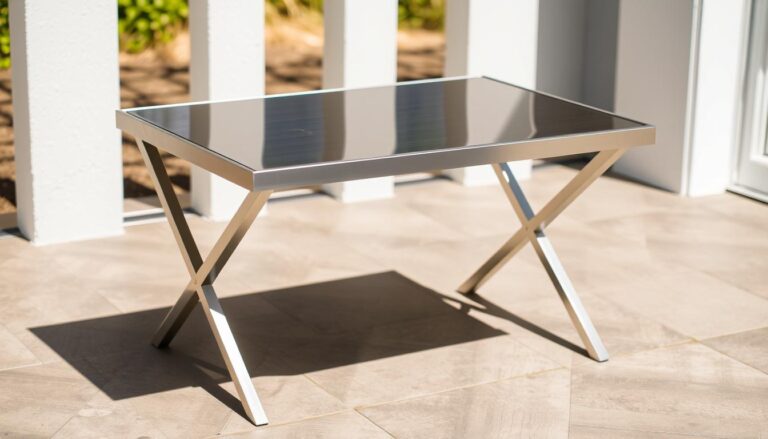
Transformer Furniture for Small Spaces: 10 Best Picks

As an Amazon Associate, I earn from qualifying purchases.
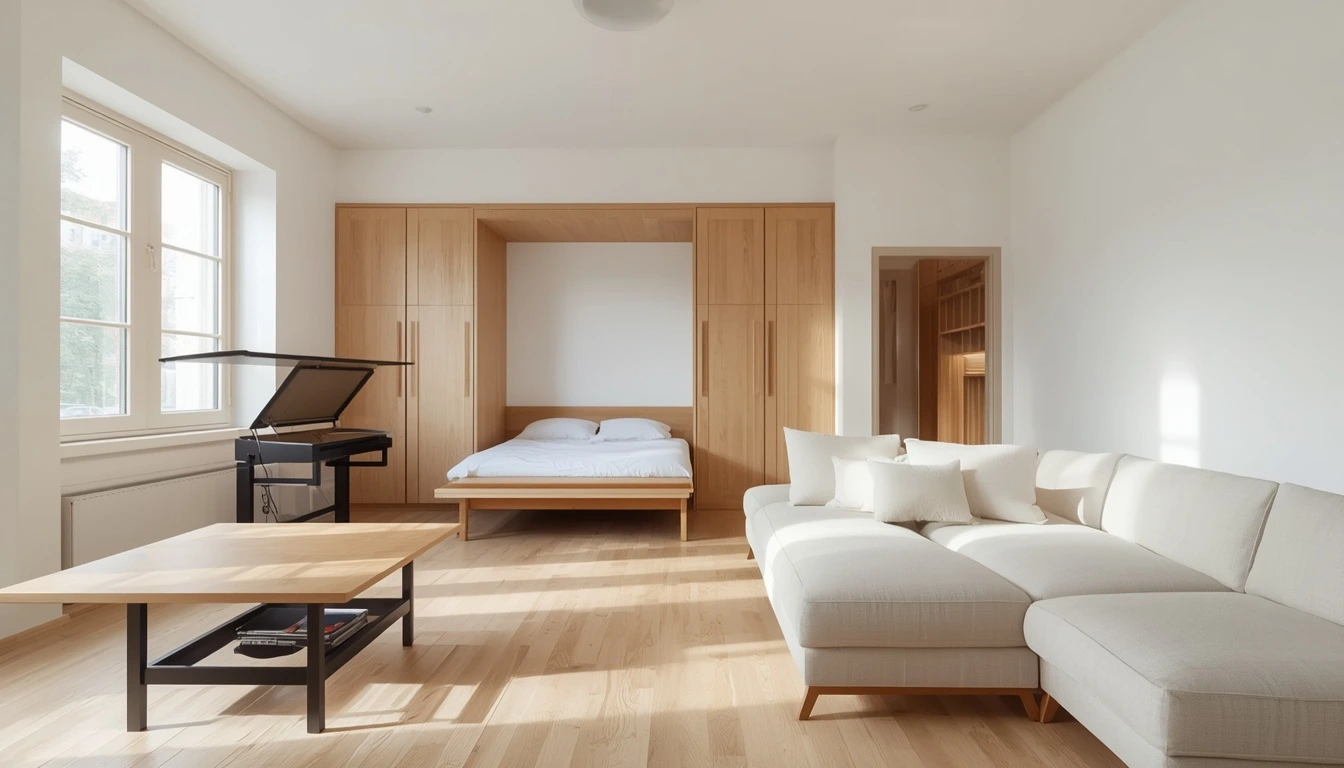
Transformer furniture for small spaces is exactly what it sounds like: furniture that physically changes shape, height, or function on demand — so you get more out of every square foot without giving anything up. These pieces fold, lift, extend, pivot, or slide to create room exactly when you need it, then disappear back into a wall, a shelf, or themselves when you don’t.
Whether you’re working with a studio apartment under 400 sq ft, a one-bedroom that doubles as a home office, or a dining room that also hosts movie nights, the right transformer furniture piece solves the equation traditional furniture can’t: how do you fit more life into less square footage?
In this guide, you’ll find 10 pieces worth knowing about — what makes each one genuinely useful, what to watch for before you buy, and which Amazon picks are worth checking out right now.
Table of Contents
- What Is Transformer Furniture?
- Coffee-to-Dining Lift Tables
- Wall Beds with Integrated Sofa
- Drop-Leaf Wall-Mounted Desks
- Extendable Dining Tables
- Sofa Beds with Gas-Lift Mechanism
- Storage Ottomans That Do Everything
- Nesting Tables
- Stackable Transforming Chairs
- Pivot Bookcase Doors
- Modular Sectional Sofas
- How to Choose the Right Transformer Piece for Your Space
- Mechanism Comparison Chart
- FAQ
What Is Transformer Furniture? {#what-is-transformer-furniture}
Transformer furniture — sometimes called convertible or multifunctional furniture — refers to any piece designed to physically change its form, size, or function on demand. The mechanism can be as simple as a drop-leaf hinge or as engineered as a hydraulic lift system. What all of these pieces share is a core promise: one piece of furniture, multiple uses, without permanently sacrificing floor space.
This category has exploded in quality over the past few years. The early versions were notoriously flimsy — a pull-out sofa with a metal bar that dug into your back, a fold-down desk that wobbled under a laptop. The newer generation of transformer furniture for small spaces uses gas pistons, soft-close hinges, and reinforced steel frames that hold up to daily use.
The result is furniture that genuinely earns its place in a small home.
1. Coffee-to-Dining Lift Tables {#coffee-to-dining-lift-tables}
This is one of the most practical transformer furniture pieces for anyone who eats, works, or entertains in their living room. A lift-top coffee table sits at standard coffee table height (around 18 inches) until you pull up the top surface, which rises and extends forward to dining or desk height — typically 28 to 30 inches.
The better models add a lower storage shelf and a second surface underneath the lift, giving you hidden space for remotes, books, or table linens.
What to look for: A smooth, one-hand lift mechanism. Cheaper versions require both hands and have a tendency to stick over time. Look for a gas-piston or spring-assist system, and verify the extended height works with your sofa — most standard sofas sit at 17 to 19 inches, so a 28-inch table height works well for seated dining.
Best use case: Studio apartments or living rooms under 250 sq ft where a separate dining table isn’t realistic.
👉 Pro Tip: Measure the clearance between your sofa and where the extended table surface will land before buying. Most lift tables extend 8 to 12 inches toward you — you want at least 6 inches of clearance so you’re not bumping your knees every meal.
A well-reviewed option worth checking: the WLIVE Lift Top Coffee Table with built-in storage compartments is a popular pick in the $150–$250 range with a reliable gas-lift mechanism. Check current availability and pricing on Amazon.
2. Wall Beds with Integrated Sofa {#wall-beds-with-integrated-sofa}
A Murphy bed with a sofa attached is the gold standard of transformer furniture for small spaces — and it’s a significant upgrade over the classic wall bed that leaves an awkward empty space in front of it during the day.
The mechanism works like this: the sofa frame is attached to the bed panel and stays in position whether the bed is up or down. When you pull the bed down, the sofa either pivots forward to create a couch-in-front-of-bed layout, or the sofa cushions serve as the mattress surface directly. Higher-end versions have a sofa that locks into a stationary position while the bed unfolds above and behind it.
What to look for: Weight capacity (most good models support 500–800 lbs), mattress type (look for memory foam compatible), and wall-mount requirements. Some Murphy bed systems require professional installation and wall studs — factor that into your budget.
Best use case: Studio apartments or guest rooms that need to function as a proper living room during the day.
Expert Warning: Always verify the wall mounting requirements before purchasing a Murphy bed system. Drywall anchors alone won’t hold the weight — you need to hit wall studs or install a proper backing board. If you’re renting, check your lease before drilling into walls.
👉 Pro Tip: If a full Murphy bed system is outside your budget, a wall bed with bookcase surround is a more affordable starting point. The bookshelves flank the bed, making the wall look intentional and styled — not like a piece of equipment parked in your living room.
For more on wall bed sizing and configurations, see the complete guide to Murphy beds for small spaces — including dimension charts by room size.
3. Drop-Leaf Wall-Mounted Desks {#drop-leaf-wall-mounted-desks}
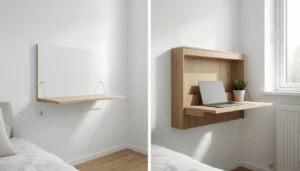
A fold-down wall desk is transformer furniture at its most elegant. Mounted flat to the wall, it takes up zero floor space when not in use. Fold it down and you have a full working surface — typically 24 to 36 inches wide — for a laptop, monitor, or writing setup. Fold it back up and the wall is clean again.
The better versions integrate shelving above and pegboard or cubbies inside the desk lid, so your supplies, chargers, and notebooks have a home even when the desk is closed.
What to look for: Surface area (you want at least 24 inches of depth for a laptop + a notebook), leg support (some models use a fold-out leg, others use a fixed bracket — the bracket is sturdier), and the hinge mechanism (piano hinge or concealed hinge both work well; avoid single-point hinges that create torque over time).
Best use case: Bedrooms that need a home office setup, or living room walls with an unused corner.
👉 Pro Tip: Mount the desk at standing desk height (42–44 inches from the floor) if you also want the option to work standing. This works especially well in kitchens and small utility spaces where sitting isn’t always practical.
A popular pick: wall-mounted folding desks with storage in the $80–$200 range offer a solid surface and a built-in organizer. Check current pricing on Amazon.
4. Extendable Dining Tables {#extendable-dining-tables}
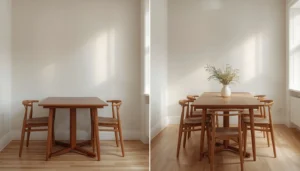
An extendable dining table is one of the most practical investments in this category because it solves a specific, recurring problem: you need seating for two on Tuesday and seating for six on Saturday.
The mechanism varies — leaf extensions that store inside the table, butterfly leaves that fold out from the center, or accordion-style gate-leg designs that expand from a slim console size to a full dining table. The console-to-dining format is the most versatile for small spaces: it sits at 12–18 inches deep against a wall when closed, then pulls out and extends to seat 4–6.
What to look for: The extension mechanism smoothness (some cheaper versions require two people to extend), leg stability at full extension, and leaf storage (ideally stored inside the table itself, not separately).
Best use case: Small dining rooms, kitchen dining areas, or open-plan living spaces where a full dining table would dominate the room.
Expert Warning: Always check the weight rating at full extension before buying. Some extendable tables are only tested at compact size — the leaf supports can weaken over years of use if not properly engineered.
For a full comparison of extendable dining table sizes and seating capacity, the guide to wall-mounted dining tables covers drop-leaf and wall-mounted options that work well alongside extendable freestanding tables.
👉 Pro Tip: If you host regularly, look for an extendable table with self-storing leaves. Tables that require you to find somewhere to put the leaf during dinner are a frustration that compounds every time you entertain.
The VASAGLE MAEZO Extendable Dining Table is a strong pick in this category — it extends smoothly with a butterfly leaf mechanism, seats up to 6 when open, and folds back to a compact 2-person size that doesn’t dominate the room. Check current pricing on Amazon.
5. Sofa Beds with Gas-Lift Mechanism {#sofa-beds-with-gas-lift-mechanism}
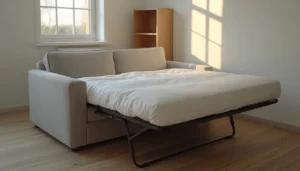
The gap between a mediocre sofa bed and a genuinely good one comes down almost entirely to the mechanism. Gas-lift sofa beds use a pneumatic piston system — the same technology in office chairs and car tailgates — to make the conversion from sofa to bed feel effortless and smooth.
Unlike older click-clac or pull-out mechanisms that require wrestling with the furniture, a gas-lift sofa bed can typically be converted in under 10 seconds with one hand. The mattress surface also tends to be flat and consistent because there’s no crossbar frame underneath — one of the most common complaints about traditional pull-out sleepers.
What to look for: The piston quality (look for a stated weight limit), the mattress thickness (anything under 4 inches will be uncomfortable for more than a night or two), and the sofa depth in its regular position (some sofa beds sacrifice seat depth to create sleeping length — check both measurements).
Best use case: Studio apartments, dedicated guest rooms that double as offices, or living rooms where overnight guests are a regular occurrence.
👉 Pro Tip: If the guest bed is used more than a few times a month, look for a sofa bed with a removable, washable cover. It’s the detail that separates a practical piece from one that looks tired within a year.
See how sofa beds compare to wall beds in the Murphy bed vs sofa bed guide — which covers load capacity, long-term comfort, and total cost by use case.
The MUDANT 58″ Convertible Sofa Bed is an Amazon’s Choice product with a 4.8-star rating. It folds flat into a floor sleeper in seconds, uses a boneless corduroy construction for comfort without the metal bar issue, and works well in studio apartments or bedroom reading nooks. Check current pricing on Amazon.
6. Storage Ottomans That Do Everything {#storage-ottomans-that-do-everything}
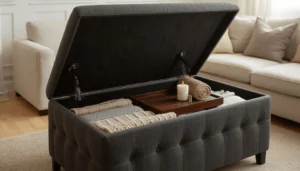
A storage ottoman isn’t glamorous — but it may be the single most efficient piece of transformer furniture for small spaces you can own. The right one functions as: a coffee table (with a tray on top), extra seating for guests, a footrest, and concealed storage for throws, board games, remote controls, or anything else taking up visual space.
The better designs use a reinforced lid with a piano hinge that stays open without slamming, and a double-walled interior that holds its shape after years of sitting weight.
What to look for: Weight capacity of the lid (some aren’t built for anyone over 150 lbs to sit on), interior dimensions (measure what you actually plan to store), and leg height (legs that are too short put the surface lower than your sofa seat, which makes it awkward as a coffee table).
Best use case: Living rooms, bedrooms, entryways — genuinely almost any room.
A well-built option to consider: the SIMPLIHOME Harrison Storage Ottoman offers a generously sized interior, a reinforced piano-hinge lid that stays open hands-free, and a tufted linen fabric that holds up to daily sitting. It works equally well as a coffee table with a tray on top, extra seating for guests, or concealed storage for throws and remotes. Check current pricing on Amazon.
7. Nesting Tables {#nesting-tables}
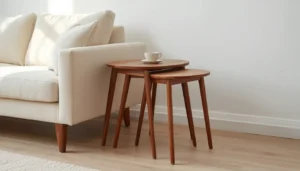
Nesting tables are a set of two or three tables of graduated sizes that slide underneath each other when not in use. In their nested position, they take up roughly the same floor space as a single end table. Pulled apart, you have multiple surface areas for drinks, snacks, laptops, or decor.
What makes modern nesting tables stronger transformer furniture is the design quality — the best sets now use solid wood, stone tops, or metal frames that hold their visual weight in a styled room rather than looking like temporary add-ons.
What to look for: Stability when separated (check that the smallest table has enough base width to stand without tipping), surface height variance (the largest should be sofa arm height, the smaller ones lower), and finish durability.
Best use case: Beside sofas or armchairs as a flexible end table setup, or in front of a sofa instead of a single coffee table.
👉 Pro Tip: A set of nesting tables in walnut or warm wood tones doubles beautifully as decorative objects when nested together. They earn their space visually even when not in use — which is the test every small-space furniture piece should pass.
Check the roundup of small coffee tables for small living rooms for a comparison of nesting tables alongside lift-top and storage coffee table options.
8. Stackable Transforming Chairs {#stackable-transforming-chairs}
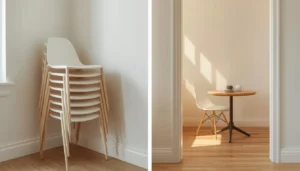
A stackable chair that converts into a stool is one of the quieter innovations in this space. Several designs on the market now allow the backrest to fold flat, reducing the stacked height to roughly 6 inches per chair — meaning four chairs in a stack take up less vertical space than a single standard dining chair.
Higher-end versions convert further: the seat detaches to become a floor cushion, or the folded chair structure creates a shelf-like tray that can hold items when leaned against a wall.
What to look for: Seat surface comfort (many stackable chairs sacrifice cushioning for storage efficiency — look for at least a molded contour or thin foam seat), fold mechanism simplicity (one-hand operation is a strong preference), and weight per chair (lighter chairs are easier to relocate quickly).
Best use case: Dining rooms that need flexible extra seating, home offices with occasional in-person meetings, or any space that entertains occasionally but can’t store dedicated dining chairs.
A reliable set to consider: the Bonnlo Modern Stackable Chairs come in sets of 4 or 6, stack cleanly for compact storage, and measure just 21″W x 21.3″D — small enough to tuck into a corner when not in use. The acrylic and birch construction keeps them visually light in a small dining room. Amazon’s Choice with strong reviews. Check current pricing on Amazon.
9. Pivot Bookcase Doors {#pivot-bookcase-doors}
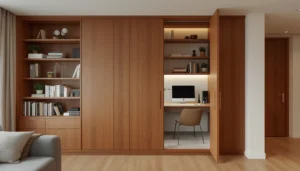
A pivot bookcase is exactly what it sounds like: a floor-to-ceiling bookcase that functions as a door, swinging open on a pivot hinge to reveal a concealed closet, home office nook, or utility space behind it.
This is transformer furniture at its most architectural — and once installed, it dramatically changes how a room functions. A wall that appeared to hold only books becomes an entry point to additional storage or a private workspace.
What to look for: Pivot hardware rated for the weight of a fully loaded bookcase (this is non-negotiable — the wrong hardware creates dangerous instability), floor clearance for the arc of the swing, and whether the design works with your ceiling height. Most kits assume 8-foot ceilings; taller rooms may need custom hardware.
Best use case: Homes with underutilized walls adjacent to closets, alcoves, or utility areas. Also excellent for creating a hidden home office in a guest room.
Expert Warning: A pivot bookcase door requires professional installation if you’re not experienced with structural hardware. The pivot point takes significant shear load over time — this is one piece of transformer furniture where cutting corners on installation creates a genuine safety risk.
For more wall-mounted furniture that reclaims vertical space, see the floating shelves guide for styling ideas that complement a pivot bookcase aesthetic.
10. Modular Sectional Sofas {#modular-sectional-sofas}
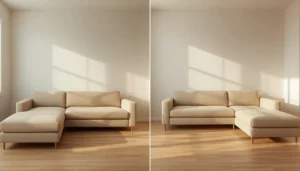
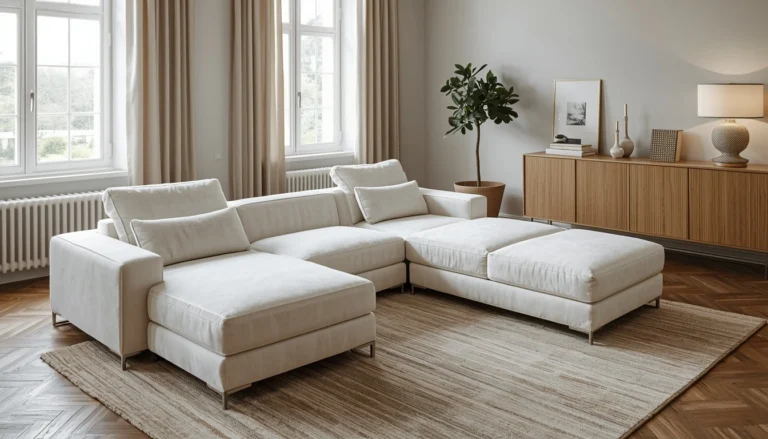
A modular sectional is transformer furniture in the truest sense of the category: it changes shape based on your layout needs, not just your space constraints. Individual sections — a left arm, right arm, backless bench, chaise, ottoman — connect via clips, tabs, or magnets, and can be rearranged into a completely different configuration in under 20 minutes.
This matters more than it sounds. A one-bedroom apartment is not the same room for a movie night, a dinner party, a work-from-home setup, and a solo reading afternoon. A modular sofa lets you reconfigure the room for each scenario without buying four different furniture pieces.
What to look for: Connection mechanism durability (check reviews specifically for sections that drift apart over time), leg leveling options (important on uneven floors), and whether additional sections can be purchased later as your space or needs change.
Best use case: Living rooms in apartments where the sofa is the main anchor piece and the layout changes regularly — and for anyone who anticipates moving in the next few years, since modular pieces adapt to new floor plans.
For full reviews and sizing guidance, the best modular sofas for small spaces guide covers specific picks by room size and budget.
The Weture 108″ Modular Sectional Sofa is a strong example of what this category can do. It reconfigures from an L-shape into a sleeper sofa, uses a boneless cloud-cushion construction for daily comfort, and has 1,200+ reviews with over 200 units sold last month alone. Available in left or right chaise configuration to fit your floor plan. Check current pricing on Amazon.
How to Choose the Right Transformer Piece for Your Space {#how-to-choose}
Before you invest in any transformer furniture for small spaces, answer three questions:
1. What’s the primary problem you’re solving? If the issue is sleeping space → wall bed or sofa bed. If it’s dining space → lift table or extendable table. If it’s workspace → wall-mounted desk. Don’t buy a piece because it’s clever — buy it because it solves something specific.
2. How often will you use the transformation? A pivot mechanism used twice a day needs to be engineered for high-cycle durability. A bookcase door opened once a week has different requirements. Match mechanism quality to frequency of use.
3. What are the real dimensions — both open and closed? The closed (storage) dimensions tell you where it lives in your room. The open (deployed) dimensions tell you whether it actually fits in your room when in use. Both measurements matter equally. Check manufacturer specs, not just photos.
👉 Pro Tip: Before purchasing any large transformer piece, tape the open and closed footprint on your floor with painter’s tape. Live with the tape outline for a day. This single step eliminates more than half of furniture return scenarios.
📊 Mechanism Comparison Chart {#mechanism-comparison-chart}
| Mechanism Type | Best For | Durability | Price Range | Operation |
|---|---|---|---|---|
| Gas-piston lift | Coffee tables, sofa beds | ⭐⭐⭐⭐⭐ | $150–$600 | One hand, smooth |
| Pneumatic Murphy bed | Wall beds, integrated sofas | ⭐⭐⭐⭐⭐ | $800–$2,500 | One hand, 3 seconds |
| Drop-leaf hinge | Desks, dining tables | ⭐⭐⭐⭐ | $80–$400 | Simple fold, reliable |
| Butterfly leaf | Extendable dining tables | ⭐⭐⭐⭐ | $300–$1,200 | Two hands, 30 seconds |
| Piano hinge | Ottoman lids, storage benches | ⭐⭐⭐⭐ | $60–$250 | Easy lift, stays open |
| Pivot (bookcase) | Bookcase doors, hidden rooms | ⭐⭐⭐⭐⭐ | $400–$2,000+ | Swing open, architectural |
| Clip/tab modular | Sectional sofas | ⭐⭐⭐ | $500–$2,000 | Reconfigure in 20 min |
| Nest/stack | Nesting tables, stackable chairs | ⭐⭐⭐⭐ | $60–$400 | Slide/lift, instant |
Price ranges reflect Amazon listings as of 2026 — check current prices before purchasing.
FAQ {#faq}
What is transformer furniture and is it worth it for small spaces? Transformer furniture refers to any piece that physically changes its form, height, or function on demand — think lift-top coffee tables, fold-down wall desks, Murphy beds, or modular sofas. For small spaces, it’s worth the investment when it replaces two or more standard furniture pieces rather than just adding a clever feature. The best transformer furniture earns floor space back — which in a studio or one-bedroom apartment has real, measurable value.
How long does transformer furniture last compared to traditional furniture? This depends almost entirely on mechanism quality. A well-engineered gas-lift table or Murphy bed system can last 15–20 years with normal use. A cheap click-clac sofa bed may show wear within 2–3 years. The clearest signal is the mechanism’s rated cycle count — high-quality gas pistons are typically rated for 50,000+ cycles. Look for that information in product specs before buying.
Is transformer furniture good for renters? Most transformer furniture is perfectly renter-friendly — lift tables, nesting tables, modular sofas, and storage ottomans require zero wall attachment. Wall-mounted pieces (fold-down desks, Murphy beds, pivot bookcases) do require drilling, so check your lease first. Many landlords approve Murphy beds because they add value to the unit, but you’ll want written permission before installing.
What’s the most practical transformer furniture piece for a studio apartment under 400 sq ft? A lift-top coffee table that rises to dining height gives you the most functional return for the investment in a studio. It replaces both a coffee table and a separate dining surface, typically costs $150–$300 on Amazon, and requires no installation. After that, a sofa bed or Murphy bed would be the next most impactful addition.
Can transformer furniture handle daily use, or is it only for occasional transformation? The best pieces in this category are designed for daily transformation. Gas-lift mechanisms in lift tables and sofa beds, for example, are the same technology used in office furniture rated for workplace use. For daily-use pieces, look for rated cycle counts in the product specs and read reviews that specifically mention long-term durability (6 months or more of ownership).
What’s the difference between a transformer sofa and a regular sofa bed? A standard sofa bed converts from sofa to sleeping surface using a pull-out metal frame or a fold-flat cushion mechanism. A transformer sofa goes further — it may reconfigure into an L-shape, a chaise, a daybed, or separate into individual sections. The conversion is faster and typically doesn’t require removing cushions. Transformer sofas generally cost more but offer more daily flexibility.
Final Thoughts
Transformer furniture for small spaces isn’t about compromise — it’s about designing your home around how you actually live. The pieces in this guide exist because small-space living has become mainstream, and the manufacturing quality has genuinely caught up with the demand.
The key is buying for your specific problem, not for novelty. One lift-top coffee table that solves your dining situation is worth more than three clever-looking pieces that don’t quite fit your routine.
Start with the mechanism comparison chart above, identify which transformation you need most, then measure your space both open and closed before adding to cart.
Your square footage isn’t the limitation — it’s the design brief.
For more small-space furniture ideas, explore the full guide to space-saving and multifunctional furniture, the wall-mounted dining table options that pair well with transformer dining pieces, and the folding table dimensions guide for exact measurements before you buy.
Disclosure: As an Amazon Associate, I earn from qualifying purchases. All product recommendations are based on independent research and are selected for their relevance to small-space living — not for commission rate. Prices and availability are subject to change; always verify on Amazon before purchasing.