Folding Table vs Extendable Table: Which Saves More Space?

INTRODUCTION
When you live in a studio apartment or a compact dining room, the table you pick defines whether the space feels livable or cramped. The folding table vs extendable table debate comes down to one practical question: how often do you need extra surface area, and where does the table go when you don’t?
After reviewing dozens of models across both categories for small-space homes, here is what actually matters — dimensions when stored, daily usability, price, and how each type fits rooms under 150 square feet. This guide will help you choose the right one for your apartment, tiny home, or small dining room.
How Each Table Type Works
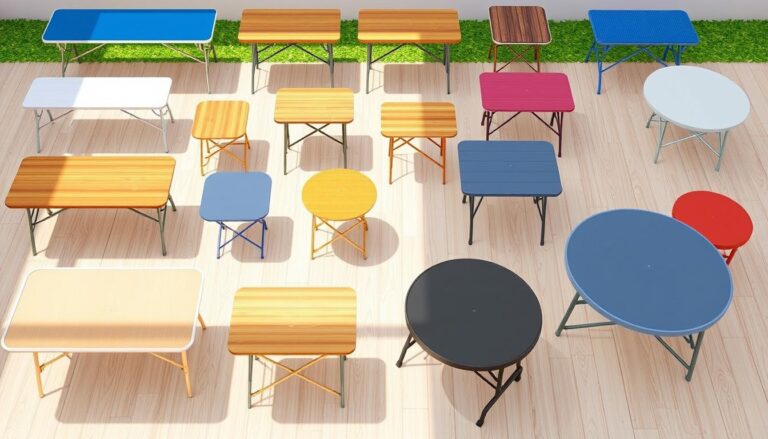
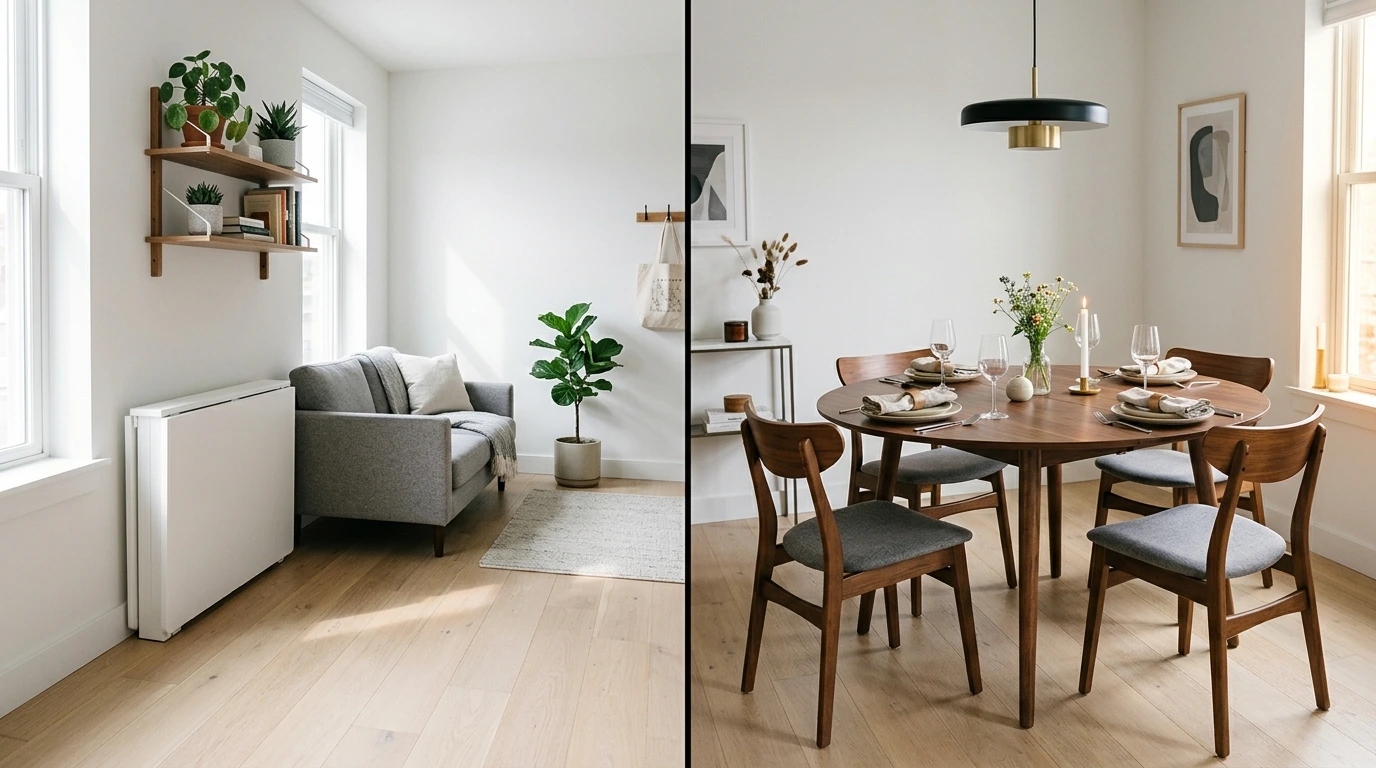
A folding table collapses entirely — legs fold under the top, and the whole unit stores flat against a wall, inside a closet, or under a bed. When folded, most residential models shrink to 3–4 inches thick, freeing up roughly 90 % of their floor footprint. Materials tend toward lightweight options like aluminum, resin, or engineered wood to keep the total weight between 15 and 25 pounds.
An extendable table stays in place permanently. Its surface area grows through a built-in mechanism — a butterfly leaf hidden inside the frame, a drop-leaf hinged on each side, or sliding tracks that pull the two halves apart so you can insert an extra panel. The base footprint never disappears; it only gets bigger. Construction leans toward solid hardwoods (oak, walnut, rubberwood) with heavier frames that typically weigh 50–80 pounds.
If you already use a folding dining table daily but find the setup routine tiring, or if you own an extendable dining table that overwhelms your kitchen, this comparison will clarify the right switch.
Folding Table vs Extendable Table: Side-by-Side Comparison
| Criterion | Folding Table | Extendable Table |
|---|---|---|
| Storage footprint | 3–4 in. thick when folded (90 % reduction) | Permanent — base stays on the floor |
| Setup time | ~30 seconds (unfold, lock legs) | 10–20 seconds (pull leaf or drop side) |
| Weight capacity | 50–100 lbs (heavy-duty: up to 350 lbs) | 150–250 lbs when fully extended |
| Typical weight | 15–25 lbs | 50–80 lbs |
| Materials | Aluminum, resin, HDPE, engineered wood | Solid oak, walnut, rubberwood, MDF+veneer |
| Price range | $25–$150 | $200–$2,000+ |
| Best room size | Under 100 sq ft (studios, RVs) | 100–200 sq ft (small dining rooms) |
| Lifespan | 5–10 years | 15–25 years with maintenance |
| Daily-use comfort | Moderate — requires daily setup | High — always ready, just expand when needed |
| Style range | Limited (utilitarian look) | Wide (farmhouse, mid-century, Scandinavian) |
The National Kitchen & Bath Association (NKBA) recommends at least 36 inches of clearance around any dining table. In a room under 120 square feet, this clearance requirement often decides the folding table vs extendable table debate by itself: if you cannot maintain 36 inches around a permanently placed table, a folding model that disappears after meals is the only workable option.
When a Folding Table Wins in Small Spaces
A folding table is the better choice when the room serves multiple purposes and the table cannot stay out permanently. Studios where the dining area doubles as a workspace, RVs and tiny homes with strict weight limits, and rental apartments where wall-mounted dining tables are not an option all favor the folding approach.
The key advantage is total floor recovery. A folding table stored vertically against a wall, behind a door, or on a wall-mounted bracket occupies near-zero living space between uses. If you host dinner once or twice a week but need open floor space every other day, folding is the practical winner.
The trade-off is tangible: folding tables feel temporary. Thinner tops flex under heavy loads, legs can wobble on uneven floors, and the style options rarely go beyond utilitarian white resin or basic wood laminate. For recommendations on the most stable models, see our best folding tables for small apartments. One reader favorite is the Office Star 4-Foot Resin Folding Table — it holds up to 350 lbs, folds to just 2.5 inches thick, and fits inside most studio apartment closets.
When an Extendable Table Wins in Small Spaces
An extendable table is the better choice when you eat at the table daily and want permanent furniture that can also accommodate guests. A compact 42-inch round extendable table seats two for weeknight dinners, then opens to 60 inches to fit six on weekends — all without moving the table or pulling anything from a closet. A strong option in this category is the Jocoevol 47″–63″ Extendable Round Table, which includes a built-in two-tier storage shelf underneath — a real bonus when every square inch counts in a small dining room.
For small dining rooms between 100 and 200 square feet, this flexibility is hard to beat. The table anchors the room’s design, works as a desk or homework station between meals, and requires zero setup when company arrives. Materials like solid walnut or oak also hold up far longer under daily use than lightweight folding alternatives. If you want to see how an extendable table complements dining room tables with built-in storage, the combination can solve both surface area and clutter problems simultaneously.
The trade-off: even the smallest extendable table has a permanent base footprint. In a room narrower than 8 feet, that footprint may block walkways or prevent cabinet doors from opening — the exact problem interior designer Coohom documented when a client’s extendable table blocked the refrigerator in a galley kitchen.
The Third Option: Drop-Leaf Tables
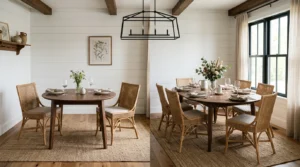
The folding table vs extendable table comparison often misses a hybrid that splits the difference. A drop-leaf table has hinged sides that fold down to console-table width (as narrow as 12 inches) but remains a permanent piece of furniture with stable legs. When both leaves are raised, it seats four comfortably.
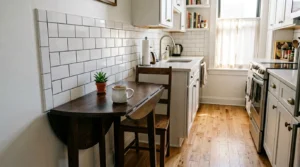
Drop-leaf tables work especially well in kitchens under 80 square feet. They push flat against a wall when not in use, serve as a breakfast bar with one leaf up, and open fully for dinner. Prices typically fall between $100 and $400 — more than a basic folding table, less than a quality extendable. The Ashley Hammis Round Drop Leaf Table is a best-seller in this category: solid birch veneer, 36 inches when open, and it shrinks to a narrow console when both leaves are down — perfect for kitchens and studios where space changes throughout the day. For more options in this hybrid category, browse our guide to wooden folding tables for small spaces.
Size Guide: Which Table Fits Your Room?
| Room Size | Recommended Table Type | Suggested Dimensions (Collapsed) | Seats |
|---|---|---|---|
| Under 80 sq ft (micro-studio, RV) | Folding or wall-mounted | 24 × 24 in. to 36 × 24 in. | 2 |
| 80–120 sq ft (studio dining area) | Drop-leaf or folding | 36 × 12 in. (leaf down) to 48 × 30 in. | 2–4 |
| 120–180 sq ft (small dining room) | Extendable | 42–48 in. round or 48 × 30 in. rectangular | 4–6 |
| 180–250 sq ft (open-plan living) | Extendable | 60 × 36 in. (expands to 84 in.) | 6–8 |
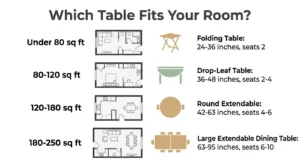
Always measure the walking paths around the table with chairs pulled out. The 36-inch clearance guideline from NKBA applies to every configuration: folding, extendable, or drop-leaf. For a detailed breakdown of folding table dimensions by size, see our folding table size chart.
Maintenance and Longevity
Folding tables need attention at the hinges. Dirt builds up in the locking mechanism and can make legs stiff or wobbly over time. Apply silicone spray to metal hinges once a year, inspect plastic latch points for hairline cracks, and always store the table dry to prevent mold between the folded surfaces.
Extendable tables require track maintenance. Brush debris out of sliding rails monthly and apply paste wax to wooden tracks or light machine oil to metal ones every six months. Store removable leaves vertically in a padded slot and rotate them quarterly to prevent warping. According to Apartment Therapy’s furniture longevity guide, well-maintained solid-wood tables can last 20 years or more, while lightweight folding models average 5–8 years of regular use.
Common Mistakes to Avoid
The most expensive mistake is buying a folding table for daily dining. Setting up and breaking down a table twice a day, every day, stops being charming after the first week. If you eat at a table daily, invest in a permanent piece — extendable or drop-leaf.
The second most common mistake is buying an extendable table without measuring the expanded footprint. A table that extends from 48 to 72 inches adds two full feet. In a narrow room, those 24 inches may block a doorway, a cabinet, or the path to the kitchen. Measure with the leaves in before you buy.
The third mistake is ignoring storage for removable leaves. Extendable tables with butterfly leaves (stored inside the table frame) eliminate this problem entirely. If the table uses separate insert panels, you need a closet, under-bed space, or wall-mounted leaf storage — all at a premium in small apartments. Our small apartment furniture checklist can help you plan storage for every piece before you buy.
Which Should You Choose?
The folding table vs extendable table decision maps directly to how often you use the table and how small the room is.
Choose a folding table if you eat at a table three times a week or less, your room is under 100 square feet, you need the floor space back between meals, or your budget is under $150. Start with our best folding tables for small apartments for tested recommendations.
Choose an extendable table if you eat at a table daily, your dining area is 120 square feet or more, you host guests regularly, and you want furniture that anchors the room’s design. Our extendable dining tables guide covers the best models for small homes.
Choose a drop-leaf table if you fall between both scenarios — daily use in a very tight space (80–120 sq ft) where a permanent full-size table will not fit. See our wall-mounted dining tables for the most compact options in this category.
FAQ
How much weight can a folding table hold?
Most residential folding tables support 50–100 pounds evenly distributed. Heavy-duty models with steel frames handle up to 350 pounds. Always check the manufacturer’s weight rating before loading heavy items.
Are extendable tables stable when fully open?
Quality extendable tables with center-support legs or apron-mounted extension hardware are very stable when expanded. Budget models with thin sliding rails can develop a slight wobble after several years. Choosing a butterfly-leaf mechanism (where the leaf stores inside the table) tends to provide the most stable extended surface.
Can I use a folding table as my permanent dining table?
Technically yes, but it is not recommended for daily use. Folding tables lack the structural rigidity of fixed furniture, the surfaces scratch and dent more easily under repeated use, and the aesthetic is difficult to integrate into a finished room. A drop-leaf table is a better permanent solution at a similar price point.
What is the best table type for an RV or van?
A wall-mounted folding table is the top choice for mobile living. It stows flat against the wall during travel, weighs under 15 pounds, and requires no floor space when not in use. Extendable tables are too heavy and too permanent for vehicles.
How do I maintain extension tracks on my extendable table?
Clean the tracks with a soft brush or vacuum monthly to remove crumbs and dust. Apply paste wax to wooden tracks or a drop of sewing-machine oil to metal tracks every six months. Never force the mechanism — if it binds, check for debris or misaligned panels before applying pressure.